It frightens me when I hear that young readers can lose as much as four months progress over the summer holidays. This is especially true for children living in poverty. Does it really mean we are back to where they were at Easter in September? What about all that great teaching? How will we ever catch up? What can we do to keep our students reading over the summer in the months we have no contact with them?
I have been doing some research to see what advice I can find, and if there are any answers to my questions.
I am always excited when a teacher invites me to their classroom to share the excitement of learning. This week I had the great pleasure of being invited back to a grade one room I have visited several times before. Thanks so much to S.F. for trusting me enough to include me, inviting me to your classroom and for being willing to share your learning.
We spent some time searching for the perfect photograph to hit all the curricular areas she wanted to address. She had an idea of where she wanted to go curricular wise,knew what interested her kids and here are the results of this Space Inquiry.
The essential question was-
What attributes might aliens need to live on other planets? How/why might these attributes be different from humans’ basic needs?
K-W-L charts What We Know What We Want to Know charts
Space Poetry
Some of the word study taught through the vocabulary in the photo:
Science outcomes covered-
Analyze different ways in which plants, animals, and humans interact with various natural and constructed environments to meet their basic needs. [CP, DM, SI]
This was taught by looking at what astronauts need in space, what I need on earth,what an alien would need to live on the planet…
Students studied the planets, designed an alien life form and considered what its needs would be to live on their chosen planet. The class also worked with the teacher librarian to develop this work. This carried the inquiry into art as well. Art was incorporated through the design of an alien and research on planets.
Many class discussion ensued and it was obvious that it was sometimes difficult for the children to understand the difference between wants and needs. The activity below was for teacher assessment.
Some of the sentences the students “shook out” from their photograph for practicing fluency, practicing the commonly used words and categorizing for paragraph writing were:
In Social Studies, an understanding of maps and globes is a required concept.
Outcome: DR1.4
Recognize globes and maps as representations of the surface of the Earth, and distinguish land and water masses on globes and maps.
Looking at the earth from above in the space photograph was a great starting point. Students also studied maps of the classroom, school and where they live.
The children had so much to tell me about their learning-they were bubbling with excitement. Here is part of their What We Learned chart !!!
I was so excited to go and work in the classroom of a former student! I felt a bit like Grandma Moses at first but the kids were great and it was really fun. Thanks to C.B. for inviting me in 🙂
If you can’t read French I think the ideas still apply.
Synthesizing is a difficult comprehension strategy for young students to name. They are able to do it quite naturally but the thinking process is not always apparent to them. In her book Reading with Meaning , Debbie Miller gave the following ideas for teaching to synthesizing:
Cover of Reading with Meaning
In order to focus the students and give them a visual of what synthesizing might look like, we talked about how some things spiral and get bigger and bigger as we add to them. We had a brainstorming session of what kinds of things they might be. Some suggestions the children gave were cinnamon buns, noodles, screws, a snow ball as you roll it in the snow. As the children were making suggestions we would print the word on the board and draw a visual being sure to show how it could grow,. Some of their examples were better than others.
We started by reading a story together. Being read to Daily is essential for beginner readers to build vocabulary and fluency as well as comprehension. In French Immersion it is even more important that we read to children daily for them to develop the language. We read the story through once. Le Cirque Charlie Chou by Marie Louise Gay.
When we were done reading the story, the teacher and I reviewed our brainstormed list of things that “synthesize”. Then we talked about how when we listen to a story our thinking can change and grow. We read the story again but this time we wrote the student comments in the spiral form . We stopped every few pages for a new thought which was added in a new colour.
At the end of the story, the children had a spiral version of the story that added more and more information as we read. They discussed how their thinking about the story really had changed and grown as the story progressed and they added more information. We read another story to them (very slowly) and let them try to write their own spiral synthesis. The physical act was actually more difficult for some of them than the thinking was. We had many types of ” spiral” forms
Our next step was to talk about non-fiction reading. We said that when we learn about a topic, every time we read or view something new our thinking changes a little. One of the children pointed out that it was almost as if you can see the brain getting bigger-smarter as you learn more.
We read parts of two books about chimpanzees together.
We talked about the fact that it isn’t very easy to write in a spiral, and that an easier way to write out our thoughts is in a graphic organizer called a web.We modled putting some information into the graphic organizer. Then as a group decided what information we wanted to add to our understanding of chimpanzees.
We showed the children that we could then take that important information we had learned and put together –synthesized- into a paragraph. We created a class paragraph together. We talked about how we synthesized all the information we had learned from our chimpanzee Read alouds and that information helped us learn about chimpanzees and then write about them. As we used information in the large web, we checked it off.
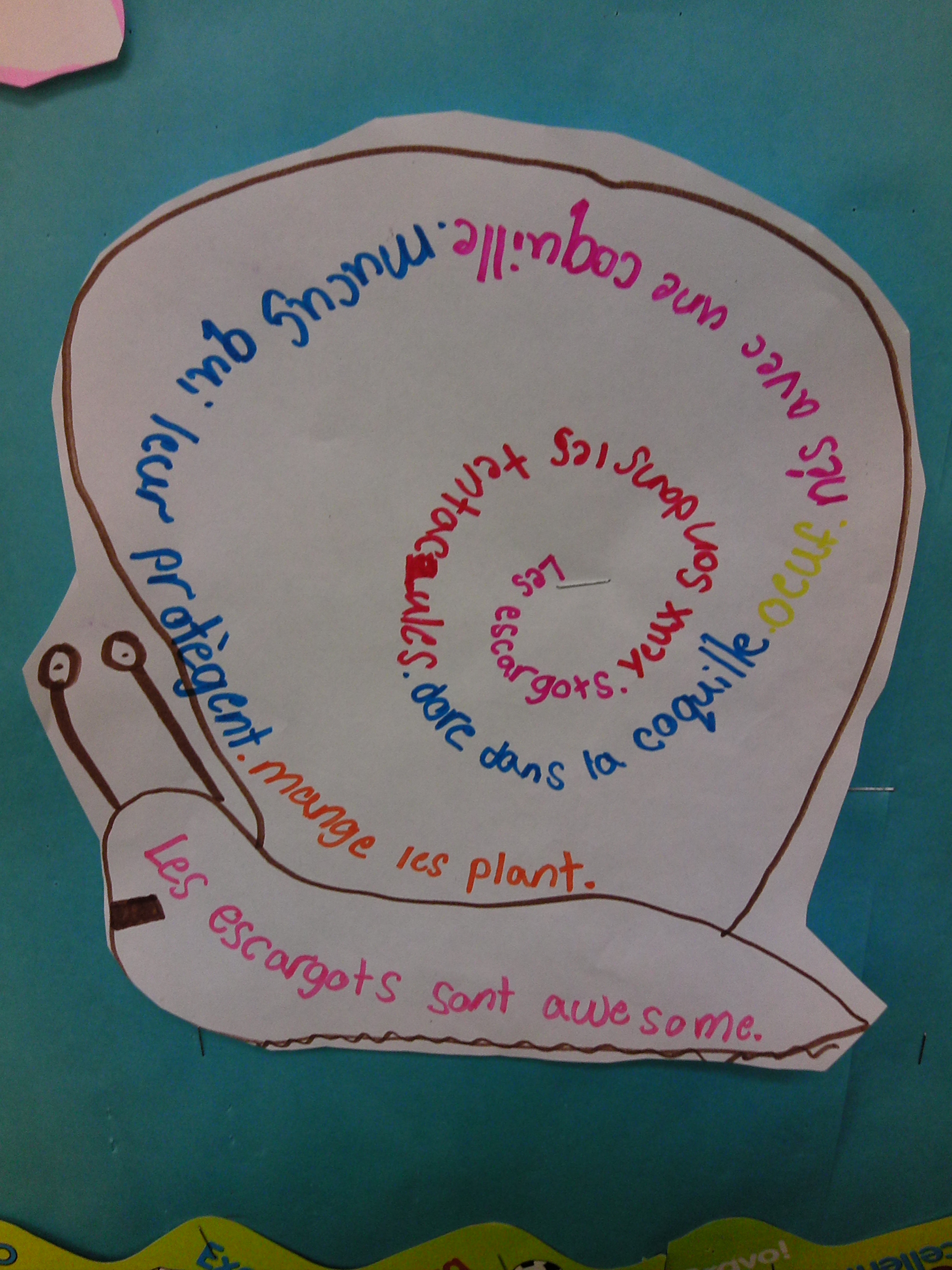
Our next step was to choose another non-fiction text and see how the children were able to synthesize the information we were giving to them about snails.
We talked about the spiral writing and how that actually looked like a snail’s shell. They were very excited to try the spiral writing again. They knew that every new piece of information was to be written in a new colour. When we were done our snail read alouds, they would create their own synthesized snail writing. Here are a couple of samples and the class bulletin board.
This is only the beginning of synthesizing. Students need to start being aware of when their thinking changes and new thinking comes in. Kind of like when we delete and re-write when we are typing. Synthesizing takes a lot of practice. Using webs and other graphic organizers to help keep track of thinking is beneficial
It is really important for students to remember the key thinking:
This idea for PWIM storage was shared with me by a teacher I have been working with. She bought the treasure chest at Ikea. Each child has their own little container in which to store their individual words and sentences. Great idea!
This is an entertaining picture book which tells the story of a dog. It is about moving, fitting in and learning a second language.The French words in the story are also in the glossary. A great read for most kids but I think French Immersion students could really relate to it.
In my role as coach and as a facilitator I have spent a lot of time explaining and more importantly modeling the Gradual Release of Responsibility. The beliefs this theory reflect are essential to creating independent, thinking, questioning students. I think it is core to who I am as a teacher but also as a parent.
Today the reality of GRR bit me in the but, challenging everything I believe in. Am I wrong? Are the teachers who tell me they can’t do it right? Are fill-in-the-blank worksheets and silent kids really the better way?
What led me to this questioning today?
I saw my daughter off at the airport as she left with her high school travel club, to Thailand. We have raised her well. She is an intelligent, independent mature young lady, full of life and wanting to spread her wings and have some adventures of her own. She is excited to share her adventures with her peers. But she has a peanut allergy and I am terrified of letting her go.
We starting out doing everything for her, making our way together through showing her and letting her try, to letting her become more and more independent giving her both voice and choice, telling her we trusted her and believed in her.
Looking at GRR in this light makes me re-think. It would have been much easier to not let her go. To refuse to help her (cheaper too) and far less worry and stress. Keeping her at home and insisting she do as we ask would have been less stressful, for a while… but when would she start to rebel, hate home, never want to come back to such a controlled environment?
So I return to my GRR beliefs and I have calmed the wild dog. I do believe classrooms must have great models, guidance with voice and choice, a belief in student ability to learn with and from each other, allow for practice time and prepare them for a future we will not be a part of and cannot possibly imagine.
Today I have to trust that my daughter will use what she has learned, and that she will adapt that knowledge, learn more, grow and have adventures far beyond my imagination. She will return home with stories and photos and begin teaching me. Now that is exciting and that is the way it should be.
Thanks to J.C. for sharing her grade one class with me 🙂
Mystery Box Writing is a fun way to increase both reading and writing skills. I present my “Mystery Box” and explain to the children that they have to figure out what I have in the box by asking me questions. In this case it was an item that was named in their PWIM photograph.
It is not a guessing game. If they think they know the what is in the box they must ask questions that will help describe what they think it might be. I will answer yes or no and provide some detail. They take turns so as not to “step on each other’s thinking”. The rules are
Once the children have discovered 12 details (on the yes side) to describe the object in the box, we read through to reinforce the information we have collected. This example was a first try at the Mystery Box with this grade one class. I realized that we have work to do on questioning. They were pretty stuck on colours for a while , but the questions did improve as we went along.
When we finished reading the chart together, they were pretty sure they knew what was in the box. As a group almost everyone was sure it was ” a toque” and they were right. I pulled my toque out of the box and showed it to them.
We compared the toque I had in the box to the toque in the photograph. We could have written a compare/ contrast paragraph together but I thought that a descriptive paragraph would be more suitable . We used the information we had gathered in the yes no chart to create a paragraph together. One little girl came up with the title and the class voted to keep it.
This is the paragraph we wrote together:
I typed up the paragraph and the students filled in the last part alone and illustrated it. They were able to practice reading the paragraph to themselves and others in order to work on their fluency as well as practice reading commonly used words.
Here are some of their paragraphs from the class book:
We had a few exciting days in our division. We invited the kindergarten, grade one and two teachers down to Central Office to spend grade alike half days together, sharing ideas for teaching word work, sentence structures ,think alouds, talk alouds for writing ,writing continuums and choosing PWIM photos with curricular connections. Teachers chose 4 of the 6 stations to go to and add new ideas to their repertoire. Each station had a little “take away” such as book marks, and other useful handouts.There was even a French Immersion section where we discussed adaptations for teaching in a second language. The room was set up in a bright,easily accessible way. Many positive comments came from this day of sharing. Thanks to the Literacy team for all the hard work!!
Susan Zimmerman describes the 7 keys to comprehension; the steps that proficient readers use in constructing a deep and sound understanding of the text they read. This book is written for parents and teachers. It has practical ideas for parents as well as teachers of young children and middle school.
She refers to the two sides of reading and how traditionally the visible side (decoding) was taught and even today the invisible side (comprehension) is frequently missed.
Visible side of reading:Sounding out or decoding words is part of the reading puzzle but falls short of real reading. If children don’t understand what they read, they’re not really reading. If they don’t unlock meaning as they read, the words are boring babble and they will never read well or enjoy reading.
Grade One Saskatchewan ELA Curriculum- Key Language Cues and Conventions for Grade 1(scroll down on link to table 5)
Grade Two Saskatchewan ELA Curriculum- Key Language Cues and Conventions for Grade 2(scroll down on link to table 5)
Grade Three Saskatchewan ELA Curriculum- Key Language Cues and Conventions for Grade 3(scroll down on link to table 5)
Invisible side of reading: Good readers use the following 7 Keys to unlock the invisible meaning:
Background knowledge (schema)
Creating mental images
Questioning
Inferring
Determining importance
Synthesizing
Monitoring for meaning
In the 1980’s, researchers identified specific thinking strategies consistently used by proficient readers. Their findings stated that reading is actually an interactive process in which good readers engage in a constant internal dialogue with the text. The ongoing dialogue helps readers to understand and further elaborate on what they read. By identifying the process, the research gave important information as to how to teach children to read it and “get it”.
Readers must learn to use these comprehension strategies in tandem not in isolation to read well. Good readers use the same strategies whether they’re reading fiction or non-fiction.
 It frightens me when I hear that young readers can lose as much as four months progress over the summer holidays. This is especially true for children living in poverty. Does it really mean we are back to where they were at Easter in September? What about all that great teaching? How will we ever catch up? What can we do to keep our students reading over the summer in the months we have no contact with them?




 Mme G.C. -Work in Progress